Rachel Thompson

Jack Canon's American Destiny

Sunday, August 11, 2013

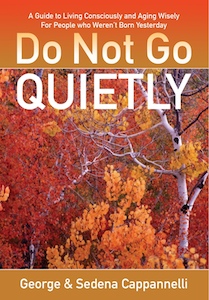
Do Not Go Quietly by George Cappannelli

The Beginning

“Everything has to do with loving and not loving.”

~ Rumi ~

Breakdown or Breakthrough

We are entering a time of demographic revolution that will, over the next several decades, result in a large number — some say half of our population — being 50 years of age or older for the first time in history. Although this revolution is still in its early stages, it is clear from the conversations and conflicts being acted out in the chambers of government and in the boardrooms of our institutions and corporations that this “graying” of the world’s population is ushering in a time of unprecedented social, political, cultural, economic, technological, and environmental change for all of us who are passengers on this train called Humanity and especially for those of us who are older GenXers, Boomers, and Elders. And this, as they say, is only the beginning.

Couple this reality with the fact that many governments, institutions, and businesses at all levels and in all parts of the world, as well as the vast majority of us — and even the organizations that are supposed to advocate for us — are unprepared for the substantial challenges and unprecedented opportunities that lie ahead. Only then does one begin to understand that this confluence of factors represents either a recipe for disaster or fertile ground for a historic breakthrough.

Do Not Go Quietly weighs in on the side of those who believe that the time ahead will provide the fertile ground for breakthrough. It advances the proposition that many of us who are older GenXers (40 to 45), Boomers (46 to 64), and Elders (65+) not only have the opportunity but the time, resources, talent, and experience. And all of us have the need to revisit the values and priorities that have guided our individual lives. Through such an essential and periodic reassessment and in other important ways, we can contribute our wisdom and experience to help steer the ship of state onto a course that promises greater well-being, environmental sustainability, social responsibility, and financial stability for ourselves and those who come after us.

So if you fall within one of these demographic categories and are interested in living more consciously and aging wisely you are, as they say, on the right page at the right time.

If you are under 40 and want to better prepare for your own road ahead — as well as to better understand the road your parents, older friends, and relatives may now be on — then you have also come to the right place.

If you want to use the time you have remaining — whether years or decades — to make right your relationship with yourself and with others, if you want to connect with greater meaning, passion, and joy and, in the process, contribute to a more positive and compassionate future, then Do Not Go Quietly is a good book for you.

We have written Do Not Go Quietly to remind all of us to use this precious gift of our lives to harvest the fruits of our past and turn them into gold that we can invest in the present and future. For only by living in each present moment with greater mindfulness can we fulfill the dreams we have come here to manifest.

Yes, we have written this book because we believe that no matter what religious beliefs or political philosophies we hold, what economic strata we belong to, what our educational background may be, or what we do or have done in the world to earn our daily bread, when we come to the end of our lives none of this will matter as much as the knowledge that we alone will hold in our hearts as to whether we have done our best to use our time, skills, heart, and resources to lead a life of genuine value and contribute to the “Common Wealth.”

Here at the outset, we want to be clear that Do Not Go Quietly is not one of those candy-coated self-help books full of pithy sound bites, designed to appeal to everyone without disturbing anyone. As we — and a number of others “who weren’t born yesterday” — already know, genuine transformation is not possible without experiencing some bumps and disturbances on the road. In fact, in our experience, without these bumps many of us would not learn the essential things we have come to Life to learn.

So you will not find “The 10 Effortless Steps to Easy Street” between these covers. Nor will you find promises of easy wealth, continual happiness, good health, the perfect waistline, and a no-cost timeshare on Maui without having to get up off the couch and work up a little sweat. So if you still believe in free rides or a life free of challenges, this is probably not your book.

Instead, Do Not Go Quietly is for those who understand that a life of genuine quality and accomplishment is most possible if we remember Helen Keller’s good advice — “life is either a daring adventure or nothing.”

Do Not Go Quietly is also for those of us who recognize that we may not have always done as good a job as we could have — as individuals, parents, friends, colleagues, leaders, lovers, and stewards of our planet. But now, with the wisdom of experience and the gift of hindsight, we still have time to do some things — both large and small — to change some of that and to leave behind a legacy that makes a positive difference in the lives of our loved ones and the larger community.

So if you believe, like we do, that you are never too old or too young to learn what you do not know, and if you find value in stories about people who have accomplished things of genuine value—particularly if you are open to being surprised that many of these people did these things when they were in their 50s and, in some cases, in their 60s, 70s, 80s and even 90s—then please join us for what we hope will be a journey that reminds you that it’s never too late to live your dreams.

If you are open to digging a little deeper into some of the larger questions that lie at the heart of life’s mysteries and exploring alternative life strategies, if you have unfinished dreams and new territories you want to explore and are interested in opening your heart even wider so that Life can have its way with you, then welcome to Do Not Go Quietly.

While we can’t promise you those “10 Effortless Steps to Easy Street,” we can promise to help you remember how remarkable you are, what extraordinary things you are still capable of expressing in this lifetime, and how much joy and satisfaction this expression will bring to you and to others.

In Part One, we will identify and explore some of the challenges and opportunities we face — individually and collectively — as a result of the graying of the world’s population. As you will see, we also issue you an invitation to do one of the most important things you can do to inherit your individual dreams and contribute to the world around you.

In Part Two you will have the opportunity to explore some concepts, questions, and recommendations we believe can help you better prepare for the road ahead.

In Part Three you will have a chance to review your past, revisit some of your beliefs and basic values, and harvest some of your valuable experiences and wisdom and turn them into real gold that you can invest in living the life you were born to live in the present and future.

In Part Four you can experience the freedom that comes from learning to put down some of the burdens of the past and avoid worrying about the future so you can live more joyfully and successfully in each present moment.

And in Part Five you can take some important steps in envisioning and mapping a future that is brighter, more engaging, and more extraordinary than you can currently imagine. For as they say, “the best is yet to come.”

Finally, throughout the book, you are given encouragement, support, and inspiration. Life Inspirations are short, motivational stories about people who demonstrate some of the best principles of conscious living. Each chapter also concludes with a section that has some Life Rules, Life Achievements, and Life Tools that will provide you with some prompts and some practical techniques to create greater balance along with enhanced physical, emotional, and mental well-being.

At the back of book, you will find a description and link to P.E.P., the valuable and restorative Portable Energy Process that Sedena has created. Originally we included some of her easy-to-do, powerful processes in the pages of this book, but realized that it would be much more helpful to you if, rather than reading them, you could follow her as she demonstrates and leads you through them. So if you would like to give your body the same kind of attention you will give your mind, emotions, and spirit as you take this journey you may want to turn to the back page or go to www.donotgoquietlythebook.com and arrange to get your copy of P.E.P.

One final note: In his inspiring work, The Book of Awakening, poet and author Mark Nepo has this to say about turning the dross of our lives into gold:

But it is too late for me, you might say, I am already full-grown. Not so, for in the world of our inwardness, we are always growing…. We can return and begin again by facing ourselves. In this way, we can go below our hardened ways to the soft impulses that birth them. Instead of breaking the bone of our stubbornness, we can nourish the marrow of our feeling unheard.… Instead of counting the scars from being hurt in the world, we can find and re-kiss the very spot in our soul where we began to withhold our trust.
Buy Now @ Amazon

Genre – Non-Fiction / Motivational

Rating – PG

More details about the author & the book

Connect with George Cappannelli on Facebook & Twitter

Website http://donotgoquietlythebook.com/

Marie Maiden – What Inspired Me To Write My Book?

What Inspired Me To Write My Book?

by Marie Maiden

I was compelled to write my book in order to share my story of how I overcome the odds that were stacked against me.  I titled my book “You Cannot Find Peace Until You Find All The Pieces” because there were many things missing from my life as a child growing up and my life as a young adult was negatively impacted by a less than desirable childhood.  I strongly desired to live a happy life so I did the work that was necessary to put the pieces of my broken life back together.

In my book, I share how I overcame many obstacles in my life. Through my story, the reader will be encouraged to overcome the obstacles in their own lives.  My book offers Hope. My book reveals the path to finding authentic living and happiness.  Life comes at you and you have to know how to deal with it.  Learn how to unlock the inner strength in you. This book is a powerful and effective tool to help the reader to discover the answers to what is missing from your life.  Read “You Cannot Find Peace Until You Find All The Pieces” by Marie Maiden.

You Cannot Find Peace

Buy Now @ Amazon

Genre - Christian / Historical / Inspirational

Rating – G

More details about the book

Connect with Marie Maiden on Twitter

Pavarti K. Tyler – How to Meet Deadlines and Remain Sane

How to Meet Deadlines and Remain Sane

by Pavarti K Tyler

When I look at my looming to-do list, I often feel a sense of dread, a building terror which threatens to consume me, overwhelm my senses and send me into a weeping mess of nerves hiding in the back of my closet.   You think I’m exaggerating, that I’m being overly hyperbolic.  I’m not.  The giant dog has often nosed open the closet door and tilted his head in confusion over what in the world I’m doing.  Silly people.  Thumbs make you all weird.

But in trying to return the closet space to my husband’s shoes, I have taken to trying to balance this whole work/life/writing/marketing/kids balance thing.  And I’ve found that one thing above all else helps me maintain my cool.

Be Reasonable

Setting reasonable expectations is the name of the game.  I cannot reasonably be asked to perform cardiac surgery anymore than I can be reasonably asked to crank out a perfectly edited and formatted 100,000 word novel in one month.  It is simply not going to happen.  I’m not that person.

Yes, there are people who can do it.  Perhaps if I really buckled down I could too.  But then, all the other things in my balance matrix would be sacrificed and that’s not conducive to a happy closet-free Pav.

This is important in all aspects of the editing process.  How long will your BETA readers take, how long will a content edit and subsequent line edit take.  Do you want ARCs available in advance of publishing?

Personally, I don’t do well with tight deadlines.  That pesky panic disorder makes me overly neurotic about making sure everything is done at exactly the right time and in exactly the right order.  Just ask my publisher, it’s my first book with Evolved and I’m already making them loony with my constant requests that things be done early.  Why early?

Build in a Buffer

You will have setbacks.  You will find that during the editing process you completely forgot to wrap up that tertiary subplot you wove in.  Crap!  Now you have to edit chapters and write a few extra to slip in.  That times time.  This will happen.  And when it does you have the choice to either delay your release (Ack!) or do a rush (read crappy) job.

However, if you’ve built in a buffer, when your crit partner bails on you half way through your MS and you have to find another or your editor takes an extra month to finish your book despite the deadline you agreed on, you still have time.  Life happens and even the best people sometimes flake. If you assume it will happen you will remain calmer.

Sounds pessimistic doesn’t it.  But that’s not how I mean it.  What I mean is, by setting reasonable expectations and then building in some buffer time, you are poised for stress free success.  But start making promises you can’t fulfill even if all the stars aligned and you will be the one perceived as the flake.

Time Table

If everything goes well and I write everyday and meet my word counts, a 60-80k book will take me 6-8 months.  So I give myself a year.  Granted, during that time, I’m usually editing, proofing and sometimes even writing other projects, so that’s not to say I take a year and do nothing but that one thing.  But it means I’m not going to commit to anything being done before then.  After that I like a month for BETA readers/crit partners and self editing, then another 2 months for the editor to work their magic.  Once the final edit is done, I like ARCs ready to go 2 months before the release date.  Add a month for inevitable shenanigans and I plot out 18 months for a book to launch.

Can it be done faster?  Sure.  White Chalk was written by 6 months.  When it launches it will be less than a year from when I started it.  Awesome huh?  The crowd roars and I take my bow.  I’m thrilled to have it out like this, but if it took longer that would have been okay.  Having it out quickly is nothing but a success.

So what’s my advice for staying sane with deadlines?  Plan for them with an outlined timetable, set them reasonably, and build in a buffer.  I just recently turned in my final draft of Sugar and Salt, an upcoming erotic novella to my editor.  It comes out in December.

White Chalk

Chelle isn’t what most people consider a typical 13-year-old girl—she doesn’t laugh with friends, play sports, or hang out at the mall after school. Instead, she navigates a world well beyond her years.

Life in Dawson, ND spins on as she grasps at people, pleading for someone to save her—to return her to the simple childhood of unicorns on her bedroom wall and stories on her father’s knee.

When Troy Christiansen walks into her life, Chelle is desperate to believe his arrival will be her salvation. So much so, she forgets to save herself. After experiencing a tragedy at school, her world begins to crack, causing a deeper scar in her already fragile psyche.

Follow Chelle’s twisted tale of modern adolescence, as she travels down the rabbit hole into a reality none of us wants to admit actually exists.

Buy Now @ Amazon

Genre - Literary Fiction/Coming of Age

Rating – R (15+)

More details about the author

Connect with Pavarti K Tyler on Facebook & Twitter

Website http://www.fightingmonkeypress.com/

Saturday, August 10, 2013

Women’s Obsession with Shoes by River Maria Urke

Introduction

  Women’s Obsession with Shoes clip_image001

A woman’s love for shoes has no boundaries. Million’s of women from all lifestyles and ages, crossing borders around the globe, care not of the necessity of shoes as much as they care of the aesthetic quality of them. The likelihood is high you know at least one friend or family member that has a love for shoes. In fact, you may be captivated yourself.

A woman’s love of a pair of shoes has been known to trump comfort for many an occasion. Some women hold the view shoes are the glue that binds an outfit together, while others base their outfit on their favorite pair of trendy shoes. The fashion of trendy and designer shoes is seen in our media traveling the globe with Stilettos on top. Carrie Bradshaw from Sex in the City is known for her obsession with designer shoes like Manolo Blahniks and Christian Louboutin. She estimates she has a $40,000 shoe collection in her New York City apartment. Carrie is a fictional character that portrays women’s obsession with shoes to an extreme. The Consumer Reports National Research Center for the shopping magazine ShopSmart conducted a poll in 2007 on women and shoes. They found that the average American woman owns 19 pairs of shoes, while 15% of women own more than 30 pairs. “Women obviously love their shoes and are willing to go to great lengths for them,” said Lisa Lee Freeman, editor-in-chief of ShopSmart.

Why are women obsessed with shoes? When did this fascination begin? A brief look at the history of shoes along with cultural factors and philosophy will help glide us a step further in understanding women’s obsession with shoes.

clip_image003

Buy Now @ Amazon

Genre – Creative Non-Fiction / Memoirs

Rating – PG

More details about the author & the book

Connect with River Urke on Facebook & Twitter & LinkedIn

Special Feature - Jessica Bell

Have you been told there’s a little too much telling in your novel? Want to remedy it? Then this is the book for you!

In Show & Tell in a Nutshell: Demonstrated Transitions from Telling to Showing you will find sixteen real scenes depicting a variety of situations, emotions, and characteristics which clearly demonstrate how to turn telling into showing. A few short writing prompts are also provided.

Not only is this pocket guide an excellent learning tool for aspiring writers, but it is a user-friendly and simple solution to honing your craft no matter how broad your writing experience. With the convenient hyper-linked Contents Page, you can toggle backward and forward from different scenes with ease. Use your e-reader’s highlighting and note-taking tools to keep notes as you read, and/or record your story ideas, anywhere, anytime.

The author, Jessica Bell, also welcomes questions via email, concerning the content of this book, or about showing vs. telling in general, at showandtellinanutshell@gmail.com

Buy Now @ Amazon

Genre – Non-Fiction / Writing Skills Reference

Rating – PG

More details about the author

Connect with Jessica Bell on Facebook &  Twitter

Blog http://thealliterativeallomorph.blogspot.com/

Have you been told you use too many adverbs and clichés in your writing? Want to remedy it? Then this is the book for you!

In Adverbs & Clichés in a Nutshell: Demonstrated Subversions of Adverbs & Clichés into Gourmet Imagery, you will find thirty-four examples of prose which clearly demonstrate how to turn those pesky adverbs and clichés into vivid and unique imagery. Extra writing prompts are also provided at the end of the book.

Not only is this pocket guide an excellent learning tool for aspiring writers, but it is a user-friendly and simple solution to honing your craft no matter how broad your writing experience. With the convenient hyper-linked Contents Page and Indexes you can toggle backward and forward from different examples with ease. Use your e-reader’s highlighting and note-taking tools to keep notes as you read, and/or record your story ideas, anywhere, anytime.

Buy Now @ Amazon

Genre – NonFiction

Rating – G

More details about the author

Connect with Jessica Bell on Facebook &  Twitter

Website http://www.jessicabellauthor.com/

Note: This cyberpunk/dystopian short story is an experimental work of fiction written in verse. Page count: 30. Word count: 2000.

It’s illegal to wear clothes. In some streets, it’s also illegal to sing. Concetta, a famous Italian a capella singer from before “the change,” breaks these laws. As punishment, her vocal chords are brutally slashed, and her eardrums surgically perforated. Unable to cope living a life without song, she resolves to drown herself in the river, clothed in a dress stained with performance memories. But Concetta’s suicide attempt is deterred, when she is distracted by a busking harpist with gold eyes and teeth. Will he show her how to sing again, or will the LEO on the prowl for another offender to detain, arrest her before she has the chance?

Buy Now @ Amazon

Genre – Cyberpunk / Dystopian / Short Story in Verse

Rating – PG13

More details about the author

Connect with Jessica Bell on Facebook &  Twitter

Website http://www.jessicabellauthor.com/

This book is not The Book. The Book is in this book. And The Book in this book is both the goodie and the baddie.

Bonnie is five. She wants to bury The Book because it is a demon that should go to hell. Penny, Bonnie’s mother, does bury The Book, but every day she digs it up and writes in it. John, Bonnie’s father, doesn’t live with them anymore. But he still likes to write in it from time to time. Ted, Bonnie’s stepfather, would like to write in The Book, but Penny won’t allow it.

To Bonnie, The Book is sadness.
To Penny, The Book is liberation.
To John, The Book is forgiveness.
To Ted, The Book is envy.
But The Book in this book isn’t what it seems at all.

If there was one thing in this world you wished you could hold in your hand, what would it be? The world bets it would be The Book.

Buy Now @ Amazon

Genre – Contemporary Fiction

Rating – PG13

More details about the author

Connect with Jessica Bell on Facebook & Twitter

Website http://www.jessicabellauthor.com/

Friday, August 9, 2013

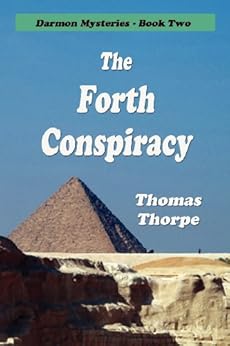
The Forth Conspiracy by THOMAS THORPE

The Forth Conspiracy by THOMAS THORPE

A thin red trail flowed over ivory-colored marble.

It curled left and crossed a second tiny stream before pausing to expand at a seam between tiles. The fluid resumed its course until a new stream snaked to join the current, sprouting from the pool of blood three feet away.

William watched the pattern evolve with morbid fascination.

The house was unusually quiet. He stood still; head cocked, listening, no sounds of servants moving or clatter of pans from the kitchen. He glanced at the pendulum clock in the hall. Ten to six.

He crouched by the body sprawled beneath the upstairs balcony.

The back of John Forthwait’s head was an ugly mass of brown twists and maroon paste. His face lay turned toward the half-parted doorway, staring with a lifeless eye and open mouth. A crumpled nightshirt draped onto the stained floor, which transformed the white cloth to a shade of burgundy.

Shuffling sounds filtered in from outside.  William straightened, hearing his brother-in-law climb the front steps.  The door swung open with a blast of morning light. Charles’ quiet conversation with Emily and Elizabeth abruptly ended.

“My God, it’s Forthwait!”

Charles twisted to shield the women’s wide-eyed glimpses. He looked back quizzically over his shoulder.

William glanced once more at the corpse, and shook his head with sudden impatience at his timid relation. “Don’t bother about that, help me roll his body over.”

They lifted the sagging flesh. Splotched fabric fell away revealing an ugly gash at the victim’s midsection.

Elizabeth darted upstairs.

Emily stood behind the men, rubbing her pale arms in an effort to stop trembling. “How could this happen? We were outside for less than an hour.”

She looked up to see her two sisters start down the curved stairway. Elizabeth clutched her sibling tightly, forcing the cringing girl to take each step toward the tragedy below. When they reached the landing, eighteen-year-old Victoria stopped to behold her boyfriend’s rumpled mass. Color drained from her face with eyes looking as lifeless as those of dead man. Abruptly, she fainted.

Charles lunged to keep her sagging head from hitting the floor. He carried her limp torso into the adjoining room and settled it onto a chesterfield. Relieved of his burden, he headed to the servant’s quarters, shouting names to arouse the household.

Cold nausea gripped William. He shot a worried glance at Elizabeth.  Neither his years at Oxford nor a sizeable fortune would do them much good in the face of a murder investigation. They had enough to worry about without this unthinkable crime at his brother-in-law’s estate.

He took his wife’s arm and looked up at the balcony above. “The wound suggests he was stabbed, and pushed over the upstairs railing,”

Elizabeth put a hand to her mouth. “No! Who would do such a thing?”

“It’s these damn Forth’s. They won’t let up until they have everything we own.  Now, somehow, one of us has killed their relation. They’ll come after us for this.”

Buy Now @ Amazon

Genre – Historical / Mystery / Thriller

Rating – PG

More details about the author & the book

Connect with Thomas Thorpe on Facebook

The Practical Guide to Happiness by Margaret Curley Sanborn

Happiness

Can You Learn to be Happy, with Who You Are, Where You Are and What You Have, Now?

If you are willing, YOU CAN, regardless of the cards you have been dealt.

The “pursuit of happiness” is a human right so basic that it’s named in the US Constitution. Unfortunately for most, it is little more than a pursuit, as happiness is elusive to many. The Practical Guide to Happiness: If you don’t like how you’re feeling, Think Again delineates, in a concrete way, the direct link between perception, thinking and feeling.

By using highly relatable stories, readers of the book are able to form a concrete link between abstract ideas regarding how they perceive and think, and how they feel. Realistic characters deal with real-life circumstances to demonstrate how the same situation and events, perceived and thought about differently, can yield different levels of happiness.

The Practical Guide to Happiness educates the reader on the number one challenge to their happiness, the human ego. The reader learns about the power of the human ego to provide a continuous negative diatribe that makes constantly holding positive beliefs about the future, in the face of the challenges of ordinary life, almost impossible. It explains how the ego will impede and thwart most people who chart a course to manifest the type of results that experts, in leading positive thinking books, cite. It then teaches the reader how to curb the ego, and to Think Again.

By using the Think Again strategies, the user learns to create happiness now, regardless of less than ideal life circumstances.

The first half of the book contains engaging stories that directly address the greatest illusions to American happiness, including: personal weight, beauty, wealth, relationships, work, retirement, and child-bearing.

Through these realistic stories, the reader is shown how even small shifts in perception and thinking create happiness and/or misery for the stories’ characters. The stories do not all have a happy ending as shifts in perception may impact the ultimate outcome, but the point of the book is to show the reader that lasting happiness is not tied to people, events or circumstances.

After drawing the reader through interesting examples of how perception and thinking create feelings, the book shifts to a practical guide the reader can use to identify, analyze and change their own negative thinking. The second half of this book is a detailed guide for changing perception and thinking to increase happiness. This section includes 8 practical actions the reader can take every day to curb their negative thinking, as well as the 6 steps required to Think Again (or change their mind).

Unlike many good books on this subject, The Practical Guide to Happiness does not have a religious bent. Although it acknowledges spirituality and God, it expressly gives readers the ability to proceed from their own beliefs, including atheism.

This book is exclusively focused on empowering the reader to become happier today, regardless of their current life challenges.

Buy Now @ Amazon

Genre – Self Help

Rating – G

More details about the author

Connect with Margaret Curley Sanborn on Twitter

Website http://www.ifuthink.com

a Rafflecopter giveaway