Rachel Thompson

Jack Canon's American Destiny

Monday, August 12, 2013

Angelina Rose – Those Review Blues …

Those Review Blues …

by Angelina Rose

According to Wikipedia, the free encyclopedia… “a book review is a form of  literary criticism in which a book is analyzed on content, style, and merit…”

For many authors, reviews are the most terrifying part of releasing their book out into the big wide world. Once the send button on a submission to a publisher or agent is hit, their book is out there, finding its way to one and all (we hope).

Reviews are important enough for some people to earn a living from… they’re a necessary part of publishing a book. Nowadays though, through the use of the internet, anyone of any age and, maybe it can also be said, with any axe to grind, can write a review on your book.

One important aspect to always remember is that each and every review is one person’s opinion only. And this opinion is certainly going to be colored by both their conscious and unconscious biases. It is also going to reflect their beliefs and values… none of us can escape our interpretation and view of life.

Statistics also reveal, there will always be a group of people who will not like, even hate your book. Let’s hope that is a small number… but they will always be there.

What do I think makes a good review?

Not all reviews are equal…

  • There are those containing a handful of words that tell you nothing. They just say the book was a good read or maybe a waste of time: they don’t tell you why.
  • When a reader, or I should say a reviewer, makes their personal biaz clear when giving a review, I take what they say seriously. At least they are honest enough to admit to what colors their viewpoint.
  • A review sounding like a book description only shows the reviewer read the book and which part of the story they enjoyed.
  • Some quality reviews are not positive reviews. These are the ones that I really give my attention to (once I get over the ego hit). They give a different view of my work and I chose to learn from these critiques.

If a reviewer can put into words what it was about your book that grabbed their imagination, or maybe didn’t grab their imagination, this then gives readers the ability to decide for themselves.

Getting over a negative review.

I actually read we need three positive reviews to negate the effect on us of one negative review. Apparently our brain is programmed to react much more strongly to negative stimuli than positive ones.

In other words, before reading your reviews, make sure you have some of your favorite chocolate on hand to help you celebrate a great review, or pick you up after a negative one.

Whether we like it or not, it’s a fact your book will receive some negative reviews, but its worth remembering a review is the opinion of only one person in the whole wide-world…

The Eyes of Love

Buy Now @ Amazon

Genre - Romance Contemporary

Rating – PG

More details about the author & the book

Connect with Angelina Rose on Facebook & Twitter

Blog http://angelinaroseromance.com/

The Critical Flaw by Alan P. Chan, Pharm. D

Chapter 1 – Money’s Fractured Foundations

Reserve Banking and Interest Creation During Money Generation

"At the end, fiat money returns to its inner value - zero."

- Voltaire, French writer

Most of us have used money all of our lives, but have rarely stopped to think about what money really is. Because economic theory is sometimes difficult to understand, many people do not take the time to find out more about our currency and the best ways to earn it, keep it, and grow it. Whether your economics-phobia came from a bad teacher in elementary school, a boring college class, or a disdain of the wonky terms and learning curve when you're an economic padawan, chances are that if you're living and working in our complex society today, you already have all of the skills and abilities needed. The first step is to understand what money is and how it is used by banks and corporations:   "A History of Economics and Investing" short course is in order.

What is money? Money is created when a loan is obtained, and it should be extinguished when the loan is repaid. Banks issue only a fraction of their deposits, but cumulative lending and borrowing create an illusion of more money being available than there actually is. Furthermore, the interest charged on loans ensures that the money supply has to expand continuously if all loans are to be repaid with interest.

With expansion of money or growth of the economy, prices rise as the increased supply of money erodes its purchasing power. As this cycle continues, the percentage of interest-to-inflation increases at the cost of real increase in production and productivity. This makes defaults and economic slowdowns inevitable.

The American foreclosure crisis shifted the control of collateral to banks. This system of money generation ensures a steady shift in wealth from the productive sector to the financial sector. Concentration of wealth and power in the hands of those who create and lend money – the banks and the government – causes the economy, society, and the civilization to decline.

History shows us that in the long run, when greed consumes everything, everybody loses. Most forecasters agree that what is needed to avoid an across-the-board loss is the responsible and shared use of resources, elimination of the concept of interest, and stabilization of the unit that is used to measure the value of goods and services.

The rate of this paradigm shift has increased dramatically with the recent creation of central banks and the government's fiscal intervention. In the meantime, the only safe and profitable investment to this shift has been gold and silver. They have risen in value as accounts based on the dollar have continued to fall.

A Quick Introduction to Monetary Systems

A monetary system is a system in which a government issues currency that is accepted as a medium of exchange in a particular country-economy or in the whole world, and creates mechanisms employed by a government or a group of governments to control and manage it. It typically consists of a central bank at the apex. Mints and other commercial banks are the other pieces in this apparatus.

The international monetary system is the institutional mechanism that determines the exchange rate among different currencies, facilitates international payments, and accommodates the movement of capital across international borders. This system developed with globalization – the increasing connectivity between different regions of the world wherein events in one part of the world produce consequences elsewhere.

Traditionally, coins made from precious metals such as gold and silver were widely used. These coins have a value of their own and continue to possess this value, even if they are not currently used for common purchases. Because gold and silver coins are quite difficult to carry, their use made buying and selling a difficult process.

Out of this difficulty emerged paper currency. The notes and coins do not have a value of their own, but are, nevertheless, used because they are easy to carry around – making buying and selling easier – and, most importantly, because they are a mutually acceptable medium of exchange.

Differences between Money, Currency, and Wealth

Money, currency, and wealth all seem the same to the casual observer and hobby economist. There are, however, subtle differences in these concepts, as well as the terms of the economy, economics, and finance. While some of these terms are very different, all are inherently connected.

An economy refers to all of the institutional mechanisms directly and indirectly related to production, distribution, exchange, and consumption of goods and services. Economics is the study of these institutional mechanisms. Finance involves all of the transactions that are conducted for obtaining and repaying loans.

Wealth is anything generally considered valuable in an economic system. Fundamentally and historically, it can be created only through the processing of natural resources by human labor. Wealth can be traded through purchases or sales with barter, the exchange of currency, and through the creation of money.

Currency is the concentrated form of wealth used for trading. We understand currency in the form of coins and paper notes, such as the American dollar, the euro, and pound sterling.

Buy Now @ Amazon

Genre – Business & Investing

Rating – PG

More details about the book

Connect with Dr.Alan Chan on Facebook & Twitter & GoodReads

Sunday, August 11, 2013

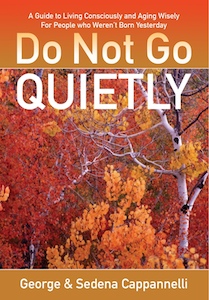
Do Not Go Quietly by George Cappannelli

The Beginning

“Everything has to do with loving and not loving.”

~ Rumi ~

Breakdown or Breakthrough

We are entering a time of demographic revolution that will, over the next several decades, result in a large number — some say half of our population — being 50 years of age or older for the first time in history. Although this revolution is still in its early stages, it is clear from the conversations and conflicts being acted out in the chambers of government and in the boardrooms of our institutions and corporations that this “graying” of the world’s population is ushering in a time of unprecedented social, political, cultural, economic, technological, and environmental change for all of us who are passengers on this train called Humanity and especially for those of us who are older GenXers, Boomers, and Elders. And this, as they say, is only the beginning.

Couple this reality with the fact that many governments, institutions, and businesses at all levels and in all parts of the world, as well as the vast majority of us — and even the organizations that are supposed to advocate for us — are unprepared for the substantial challenges and unprecedented opportunities that lie ahead. Only then does one begin to understand that this confluence of factors represents either a recipe for disaster or fertile ground for a historic breakthrough.

Do Not Go Quietly weighs in on the side of those who believe that the time ahead will provide the fertile ground for breakthrough. It advances the proposition that many of us who are older GenXers (40 to 45), Boomers (46 to 64), and Elders (65+) not only have the opportunity but the time, resources, talent, and experience. And all of us have the need to revisit the values and priorities that have guided our individual lives. Through such an essential and periodic reassessment and in other important ways, we can contribute our wisdom and experience to help steer the ship of state onto a course that promises greater well-being, environmental sustainability, social responsibility, and financial stability for ourselves and those who come after us.

So if you fall within one of these demographic categories and are interested in living more consciously and aging wisely you are, as they say, on the right page at the right time.

If you are under 40 and want to better prepare for your own road ahead — as well as to better understand the road your parents, older friends, and relatives may now be on — then you have also come to the right place.

If you want to use the time you have remaining — whether years or decades — to make right your relationship with yourself and with others, if you want to connect with greater meaning, passion, and joy and, in the process, contribute to a more positive and compassionate future, then Do Not Go Quietly is a good book for you.

We have written Do Not Go Quietly to remind all of us to use this precious gift of our lives to harvest the fruits of our past and turn them into gold that we can invest in the present and future. For only by living in each present moment with greater mindfulness can we fulfill the dreams we have come here to manifest.

Yes, we have written this book because we believe that no matter what religious beliefs or political philosophies we hold, what economic strata we belong to, what our educational background may be, or what we do or have done in the world to earn our daily bread, when we come to the end of our lives none of this will matter as much as the knowledge that we alone will hold in our hearts as to whether we have done our best to use our time, skills, heart, and resources to lead a life of genuine value and contribute to the “Common Wealth.”

Here at the outset, we want to be clear that Do Not Go Quietly is not one of those candy-coated self-help books full of pithy sound bites, designed to appeal to everyone without disturbing anyone. As we — and a number of others “who weren’t born yesterday” — already know, genuine transformation is not possible without experiencing some bumps and disturbances on the road. In fact, in our experience, without these bumps many of us would not learn the essential things we have come to Life to learn.

So you will not find “The 10 Effortless Steps to Easy Street” between these covers. Nor will you find promises of easy wealth, continual happiness, good health, the perfect waistline, and a no-cost timeshare on Maui without having to get up off the couch and work up a little sweat. So if you still believe in free rides or a life free of challenges, this is probably not your book.

Instead, Do Not Go Quietly is for those who understand that a life of genuine quality and accomplishment is most possible if we remember Helen Keller’s good advice — “life is either a daring adventure or nothing.”

Do Not Go Quietly is also for those of us who recognize that we may not have always done as good a job as we could have — as individuals, parents, friends, colleagues, leaders, lovers, and stewards of our planet. But now, with the wisdom of experience and the gift of hindsight, we still have time to do some things — both large and small — to change some of that and to leave behind a legacy that makes a positive difference in the lives of our loved ones and the larger community.

So if you believe, like we do, that you are never too old or too young to learn what you do not know, and if you find value in stories about people who have accomplished things of genuine value—particularly if you are open to being surprised that many of these people did these things when they were in their 50s and, in some cases, in their 60s, 70s, 80s and even 90s—then please join us for what we hope will be a journey that reminds you that it’s never too late to live your dreams.

If you are open to digging a little deeper into some of the larger questions that lie at the heart of life’s mysteries and exploring alternative life strategies, if you have unfinished dreams and new territories you want to explore and are interested in opening your heart even wider so that Life can have its way with you, then welcome to Do Not Go Quietly.

While we can’t promise you those “10 Effortless Steps to Easy Street,” we can promise to help you remember how remarkable you are, what extraordinary things you are still capable of expressing in this lifetime, and how much joy and satisfaction this expression will bring to you and to others.

In Part One, we will identify and explore some of the challenges and opportunities we face — individually and collectively — as a result of the graying of the world’s population. As you will see, we also issue you an invitation to do one of the most important things you can do to inherit your individual dreams and contribute to the world around you.

In Part Two you will have the opportunity to explore some concepts, questions, and recommendations we believe can help you better prepare for the road ahead.

In Part Three you will have a chance to review your past, revisit some of your beliefs and basic values, and harvest some of your valuable experiences and wisdom and turn them into real gold that you can invest in living the life you were born to live in the present and future.

In Part Four you can experience the freedom that comes from learning to put down some of the burdens of the past and avoid worrying about the future so you can live more joyfully and successfully in each present moment.

And in Part Five you can take some important steps in envisioning and mapping a future that is brighter, more engaging, and more extraordinary than you can currently imagine. For as they say, “the best is yet to come.”

Finally, throughout the book, you are given encouragement, support, and inspiration. Life Inspirations are short, motivational stories about people who demonstrate some of the best principles of conscious living. Each chapter also concludes with a section that has some Life Rules, Life Achievements, and Life Tools that will provide you with some prompts and some practical techniques to create greater balance along with enhanced physical, emotional, and mental well-being.

At the back of book, you will find a description and link to P.E.P., the valuable and restorative Portable Energy Process that Sedena has created. Originally we included some of her easy-to-do, powerful processes in the pages of this book, but realized that it would be much more helpful to you if, rather than reading them, you could follow her as she demonstrates and leads you through them. So if you would like to give your body the same kind of attention you will give your mind, emotions, and spirit as you take this journey you may want to turn to the back page or go to www.donotgoquietlythebook.com and arrange to get your copy of P.E.P.

One final note: In his inspiring work, The Book of Awakening, poet and author Mark Nepo has this to say about turning the dross of our lives into gold:

But it is too late for me, you might say, I am already full-grown. Not so, for in the world of our inwardness, we are always growing…. We can return and begin again by facing ourselves. In this way, we can go below our hardened ways to the soft impulses that birth them. Instead of breaking the bone of our stubbornness, we can nourish the marrow of our feeling unheard.… Instead of counting the scars from being hurt in the world, we can find and re-kiss the very spot in our soul where we began to withhold our trust.
Buy Now @ Amazon

Genre – Non-Fiction / Motivational

Rating – PG

More details about the author & the book

Connect with George Cappannelli on Facebook & Twitter

Website http://donotgoquietlythebook.com/

Marie Maiden – What Inspired Me To Write My Book?

What Inspired Me To Write My Book?

by Marie Maiden

I was compelled to write my book in order to share my story of how I overcome the odds that were stacked against me.  I titled my book “You Cannot Find Peace Until You Find All The Pieces” because there were many things missing from my life as a child growing up and my life as a young adult was negatively impacted by a less than desirable childhood.  I strongly desired to live a happy life so I did the work that was necessary to put the pieces of my broken life back together.

In my book, I share how I overcame many obstacles in my life. Through my story, the reader will be encouraged to overcome the obstacles in their own lives.  My book offers Hope. My book reveals the path to finding authentic living and happiness.  Life comes at you and you have to know how to deal with it.  Learn how to unlock the inner strength in you. This book is a powerful and effective tool to help the reader to discover the answers to what is missing from your life.  Read “You Cannot Find Peace Until You Find All The Pieces” by Marie Maiden.

You Cannot Find Peace

Buy Now @ Amazon

Genre - Christian / Historical / Inspirational

Rating – G

More details about the book

Connect with Marie Maiden on Twitter

Pavarti K. Tyler – How to Meet Deadlines and Remain Sane

How to Meet Deadlines and Remain Sane

by Pavarti K Tyler

When I look at my looming to-do list, I often feel a sense of dread, a building terror which threatens to consume me, overwhelm my senses and send me into a weeping mess of nerves hiding in the back of my closet.   You think I’m exaggerating, that I’m being overly hyperbolic.  I’m not.  The giant dog has often nosed open the closet door and tilted his head in confusion over what in the world I’m doing.  Silly people.  Thumbs make you all weird.

But in trying to return the closet space to my husband’s shoes, I have taken to trying to balance this whole work/life/writing/marketing/kids balance thing.  And I’ve found that one thing above all else helps me maintain my cool.

Be Reasonable

Setting reasonable expectations is the name of the game.  I cannot reasonably be asked to perform cardiac surgery anymore than I can be reasonably asked to crank out a perfectly edited and formatted 100,000 word novel in one month.  It is simply not going to happen.  I’m not that person.

Yes, there are people who can do it.  Perhaps if I really buckled down I could too.  But then, all the other things in my balance matrix would be sacrificed and that’s not conducive to a happy closet-free Pav.

This is important in all aspects of the editing process.  How long will your BETA readers take, how long will a content edit and subsequent line edit take.  Do you want ARCs available in advance of publishing?

Personally, I don’t do well with tight deadlines.  That pesky panic disorder makes me overly neurotic about making sure everything is done at exactly the right time and in exactly the right order.  Just ask my publisher, it’s my first book with Evolved and I’m already making them loony with my constant requests that things be done early.  Why early?

Build in a Buffer

You will have setbacks.  You will find that during the editing process you completely forgot to wrap up that tertiary subplot you wove in.  Crap!  Now you have to edit chapters and write a few extra to slip in.  That times time.  This will happen.  And when it does you have the choice to either delay your release (Ack!) or do a rush (read crappy) job.

However, if you’ve built in a buffer, when your crit partner bails on you half way through your MS and you have to find another or your editor takes an extra month to finish your book despite the deadline you agreed on, you still have time.  Life happens and even the best people sometimes flake. If you assume it will happen you will remain calmer.

Sounds pessimistic doesn’t it.  But that’s not how I mean it.  What I mean is, by setting reasonable expectations and then building in some buffer time, you are poised for stress free success.  But start making promises you can’t fulfill even if all the stars aligned and you will be the one perceived as the flake.

Time Table

If everything goes well and I write everyday and meet my word counts, a 60-80k book will take me 6-8 months.  So I give myself a year.  Granted, during that time, I’m usually editing, proofing and sometimes even writing other projects, so that’s not to say I take a year and do nothing but that one thing.  But it means I’m not going to commit to anything being done before then.  After that I like a month for BETA readers/crit partners and self editing, then another 2 months for the editor to work their magic.  Once the final edit is done, I like ARCs ready to go 2 months before the release date.  Add a month for inevitable shenanigans and I plot out 18 months for a book to launch.

Can it be done faster?  Sure.  White Chalk was written by 6 months.  When it launches it will be less than a year from when I started it.  Awesome huh?  The crowd roars and I take my bow.  I’m thrilled to have it out like this, but if it took longer that would have been okay.  Having it out quickly is nothing but a success.

So what’s my advice for staying sane with deadlines?  Plan for them with an outlined timetable, set them reasonably, and build in a buffer.  I just recently turned in my final draft of Sugar and Salt, an upcoming erotic novella to my editor.  It comes out in December.

White Chalk

Chelle isn’t what most people consider a typical 13-year-old girl—she doesn’t laugh with friends, play sports, or hang out at the mall after school. Instead, she navigates a world well beyond her years.

Life in Dawson, ND spins on as she grasps at people, pleading for someone to save her—to return her to the simple childhood of unicorns on her bedroom wall and stories on her father’s knee.

When Troy Christiansen walks into her life, Chelle is desperate to believe his arrival will be her salvation. So much so, she forgets to save herself. After experiencing a tragedy at school, her world begins to crack, causing a deeper scar in her already fragile psyche.

Follow Chelle’s twisted tale of modern adolescence, as she travels down the rabbit hole into a reality none of us wants to admit actually exists.

Buy Now @ Amazon

Genre - Literary Fiction/Coming of Age

Rating – R (15+)

More details about the author

Connect with Pavarti K Tyler on Facebook & Twitter

Website http://www.fightingmonkeypress.com/

Saturday, August 10, 2013

Women’s Obsession with Shoes by River Maria Urke

Introduction

  Women’s Obsession with Shoes clip_image001

A woman’s love for shoes has no boundaries. Million’s of women from all lifestyles and ages, crossing borders around the globe, care not of the necessity of shoes as much as they care of the aesthetic quality of them. The likelihood is high you know at least one friend or family member that has a love for shoes. In fact, you may be captivated yourself.

A woman’s love of a pair of shoes has been known to trump comfort for many an occasion. Some women hold the view shoes are the glue that binds an outfit together, while others base their outfit on their favorite pair of trendy shoes. The fashion of trendy and designer shoes is seen in our media traveling the globe with Stilettos on top. Carrie Bradshaw from Sex in the City is known for her obsession with designer shoes like Manolo Blahniks and Christian Louboutin. She estimates she has a $40,000 shoe collection in her New York City apartment. Carrie is a fictional character that portrays women’s obsession with shoes to an extreme. The Consumer Reports National Research Center for the shopping magazine ShopSmart conducted a poll in 2007 on women and shoes. They found that the average American woman owns 19 pairs of shoes, while 15% of women own more than 30 pairs. “Women obviously love their shoes and are willing to go to great lengths for them,” said Lisa Lee Freeman, editor-in-chief of ShopSmart.

Why are women obsessed with shoes? When did this fascination begin? A brief look at the history of shoes along with cultural factors and philosophy will help glide us a step further in understanding women’s obsession with shoes.

clip_image003

Buy Now @ Amazon

Genre – Creative Non-Fiction / Memoirs

Rating – PG

More details about the author & the book

Connect with River Urke on Facebook & Twitter & LinkedIn

Special Feature - Jessica Bell

Have you been told there’s a little too much telling in your novel? Want to remedy it? Then this is the book for you!

In Show & Tell in a Nutshell: Demonstrated Transitions from Telling to Showing you will find sixteen real scenes depicting a variety of situations, emotions, and characteristics which clearly demonstrate how to turn telling into showing. A few short writing prompts are also provided.

Not only is this pocket guide an excellent learning tool for aspiring writers, but it is a user-friendly and simple solution to honing your craft no matter how broad your writing experience. With the convenient hyper-linked Contents Page, you can toggle backward and forward from different scenes with ease. Use your e-reader’s highlighting and note-taking tools to keep notes as you read, and/or record your story ideas, anywhere, anytime.

The author, Jessica Bell, also welcomes questions via email, concerning the content of this book, or about showing vs. telling in general, at showandtellinanutshell@gmail.com

Buy Now @ Amazon

Genre – Non-Fiction / Writing Skills Reference

Rating – PG

More details about the author

Connect with Jessica Bell on FacebookTwitter

Blog http://thealliterativeallomorph.blogspot.com/

Have you been told you use too many adverbs and clichés in your writing? Want to remedy it? Then this is the book for you!

In Adverbs & Clichés in a Nutshell: Demonstrated Subversions of Adverbs & Clichés into Gourmet Imagery, you will find thirty-four examples of prose which clearly demonstrate how to turn those pesky adverbs and clichés into vivid and unique imagery. Extra writing prompts are also provided at the end of the book.

Not only is this pocket guide an excellent learning tool for aspiring writers, but it is a user-friendly and simple solution to honing your craft no matter how broad your writing experience. With the convenient hyper-linked Contents Page and Indexes you can toggle backward and forward from different examples with ease. Use your e-reader’s highlighting and note-taking tools to keep notes as you read, and/or record your story ideas, anywhere, anytime.

Buy Now @ Amazon

Genre – NonFiction

Rating – G

More details about the author

Connect with Jessica Bell on FacebookTwitter

Website http://www.jessicabellauthor.com/

Note: This cyberpunk/dystopian short story is an experimental work of fiction written in verse. Page count: 30. Word count: 2000.

It’s illegal to wear clothes. In some streets, it’s also illegal to sing. Concetta, a famous Italian a capella singer from before “the change,” breaks these laws. As punishment, her vocal chords are brutally slashed, and her eardrums surgically perforated. Unable to cope living a life without song, she resolves to drown herself in the river, clothed in a dress stained with performance memories. But Concetta’s suicide attempt is deterred, when she is distracted by a busking harpist with gold eyes and teeth. Will he show her how to sing again, or will the LEO on the prowl for another offender to detain, arrest her before she has the chance?

Buy Now @ Amazon

Genre – Cyberpunk / Dystopian / Short Story in Verse

Rating – PG13

More details about the author

Connect with Jessica Bell on FacebookTwitter

Website http://www.jessicabellauthor.com/

This book is not The Book. The Book is in this book. And The Book in this book is both the goodie and the baddie.

Bonnie is five. She wants to bury The Book because it is a demon that should go to hell. Penny, Bonnie’s mother, does bury The Book, but every day she digs it up and writes in it. John, Bonnie’s father, doesn’t live with them anymore. But he still likes to write in it from time to time. Ted, Bonnie’s stepfather, would like to write in The Book, but Penny won’t allow it.

To Bonnie, The Book is sadness.
To Penny, The Book is liberation.
To John, The Book is forgiveness.
To Ted, The Book is envy.
But The Book in this book isn’t what it seems at all.

If there was one thing in this world you wished you could hold in your hand, what would it be? The world bets it would be The Book.

Buy Now @ Amazon

Genre – Contemporary Fiction

Rating – PG13

More details about the author

Connect with Jessica Bell on Facebook & Twitter

Website http://www.jessicabellauthor.com/